Hey everybody! Happy Halloween! Yeah, I know I’m a bit late. Sorry about the delay. I meant to upload this blog post yesterday for the Fishing Fridays series. But I’ve been busy doing Halloween things. Giving candy to trick-or-treaters, carving pumpkins, and cleaning up pumpkin guts. Anyways, rockpools.
In case you didn’t know, I’m currently living in Cornwall. It’s a county on the southwestern tip of England. 3/4 sides of it face the sea. That’s 422 miles of coastline. And where there’s coast, there are rockpools.
What’s a rockpool? Are people in Cornwall plunging into pools of rocks? No, it’s a pool of sea water. But there’s a catch: these pools only form after the tide goes out. At high tide, they’re just part of the sea floor; at low tide, the sea leaves behind pockets of water cut off by surrounding rocks.
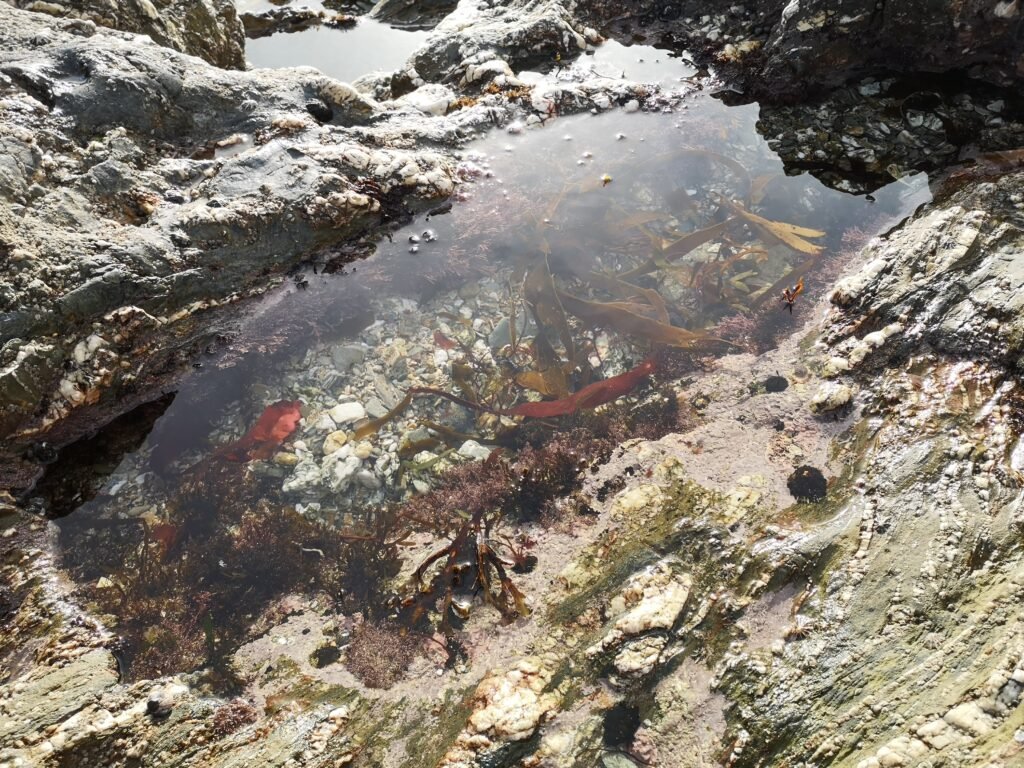
Two weeks ago, I went down to one of Cornwall’s hundreds of beaches to explore the rockpools and the sea creatures that live in them. If you’ve never gone rockpooling before…firstly, what are you doing? Secondly, you should change that.
The best time to go rockpooling is from late spring to early autumn. When the weather is calm (i.e. not in the middle of a storm) and the tide is low. You have to time it like you’re in a Bond film because tide times change — every day. A typical beach experiences two high tides and two low tides every day. And each tidal phase takes about six hours.
So the most important part is to check what time low tide will be at the beach you’re visiting. You can use the Just Tides app, which gives you precise predictions in real-time.
I actually went to the same beach twice to experience both low tides. I wanted to see which sea creatures would be around in the day and at night. My first visit to the beach was much easier. Mostly because it was during daytime and I could actually see where I was going.
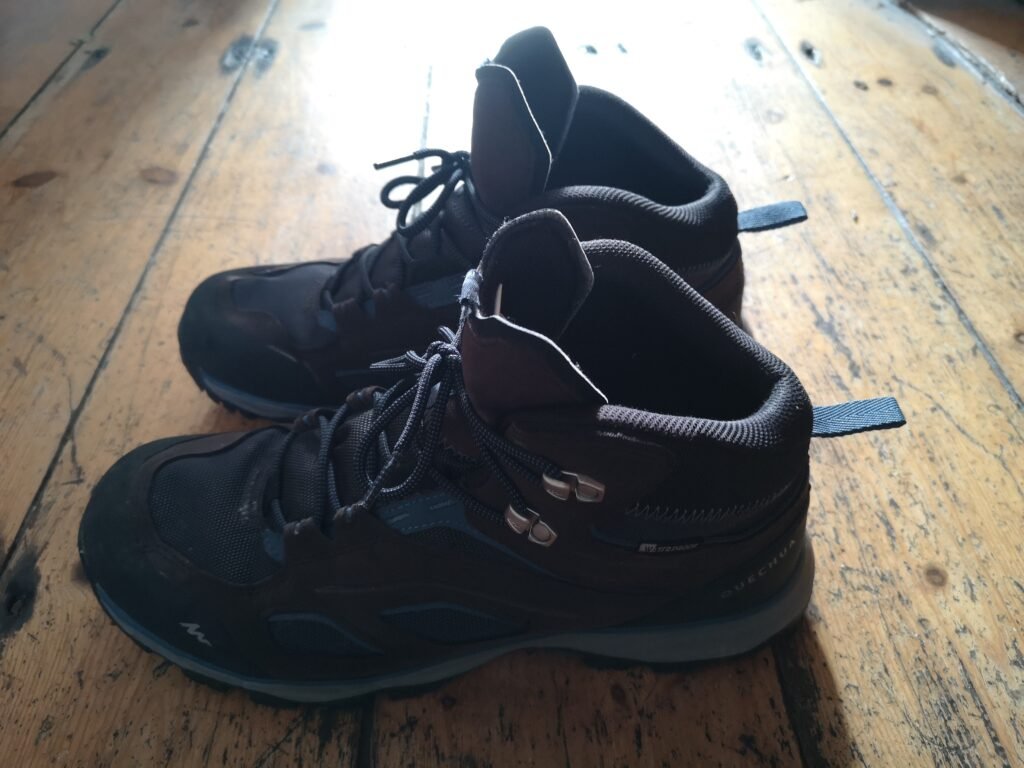
Pro tip: don’t go wearing flip flops or sandals. Wear boots. Why? Rockpools form on rocky coasts. Emphasis on rocky. There are sharp rocks, slippery rocks, rocks piled on top of more rocks. Very rugged terrain. So I wore my Quechua hiking boots. They’ve spared my feet of many cuts over the years. They’re beautiful.
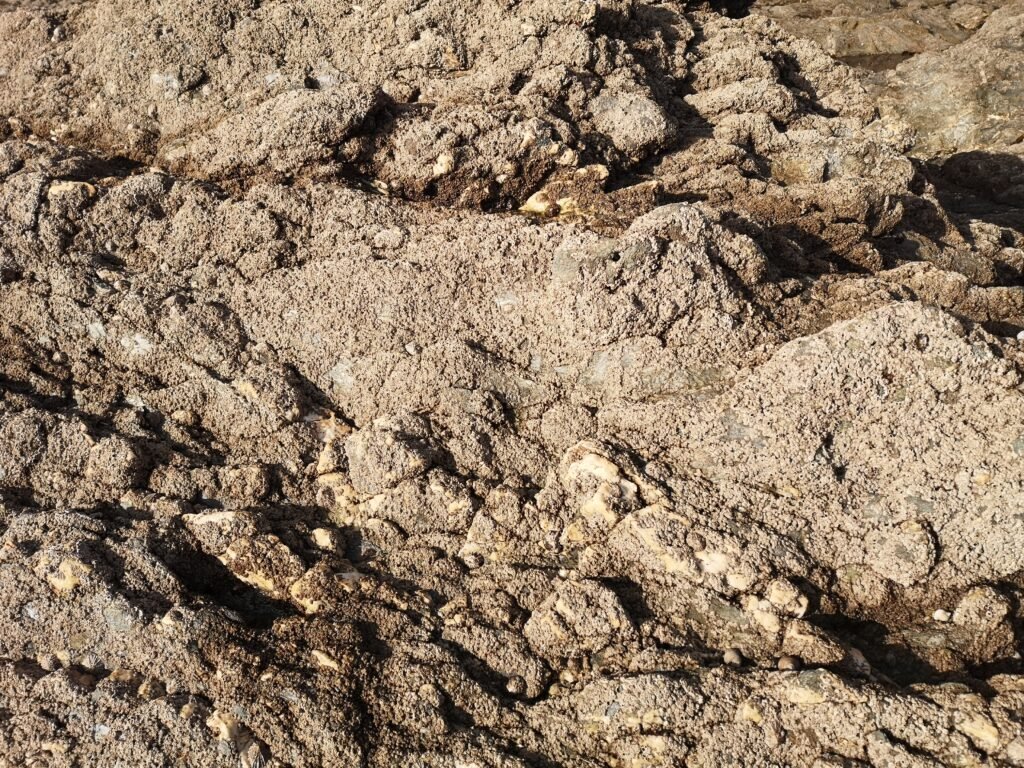
A lot of the rocks were also sticking grounds for barnacles, which would’ve felt like walking on a cheese grater. Lovely.
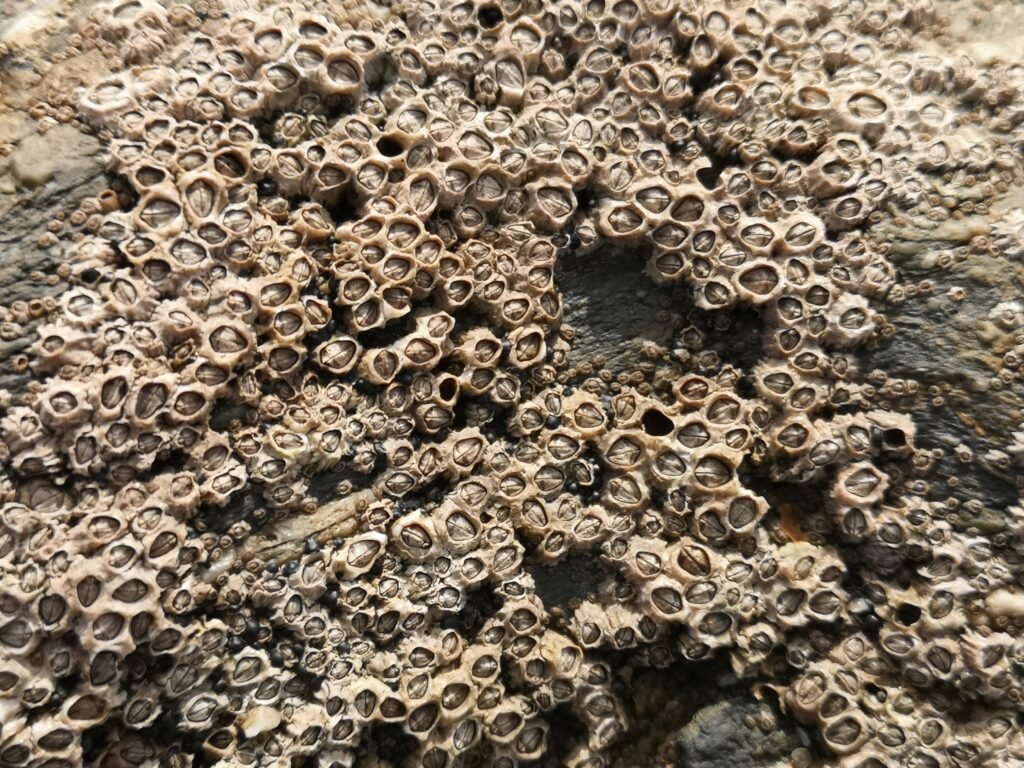
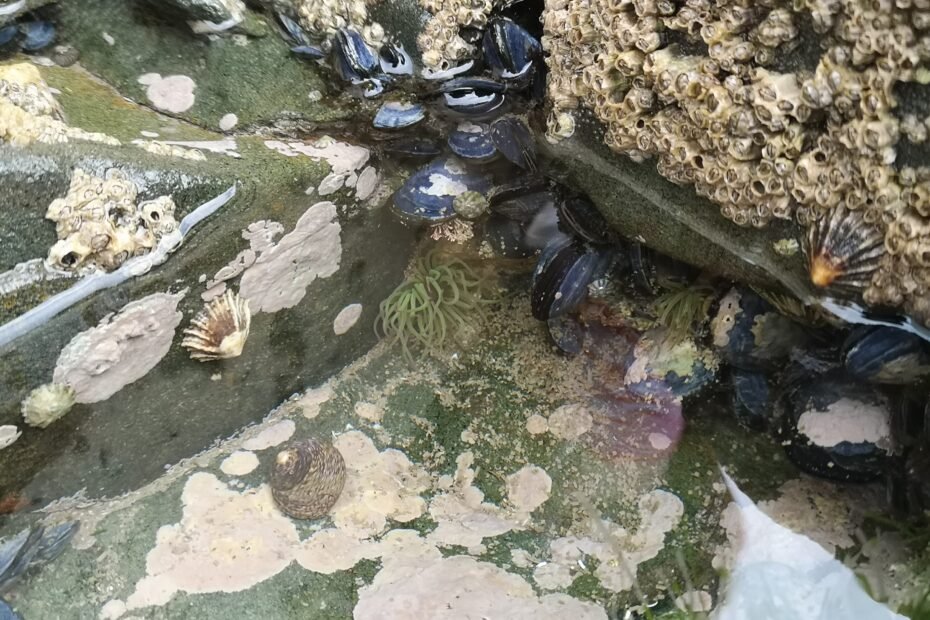
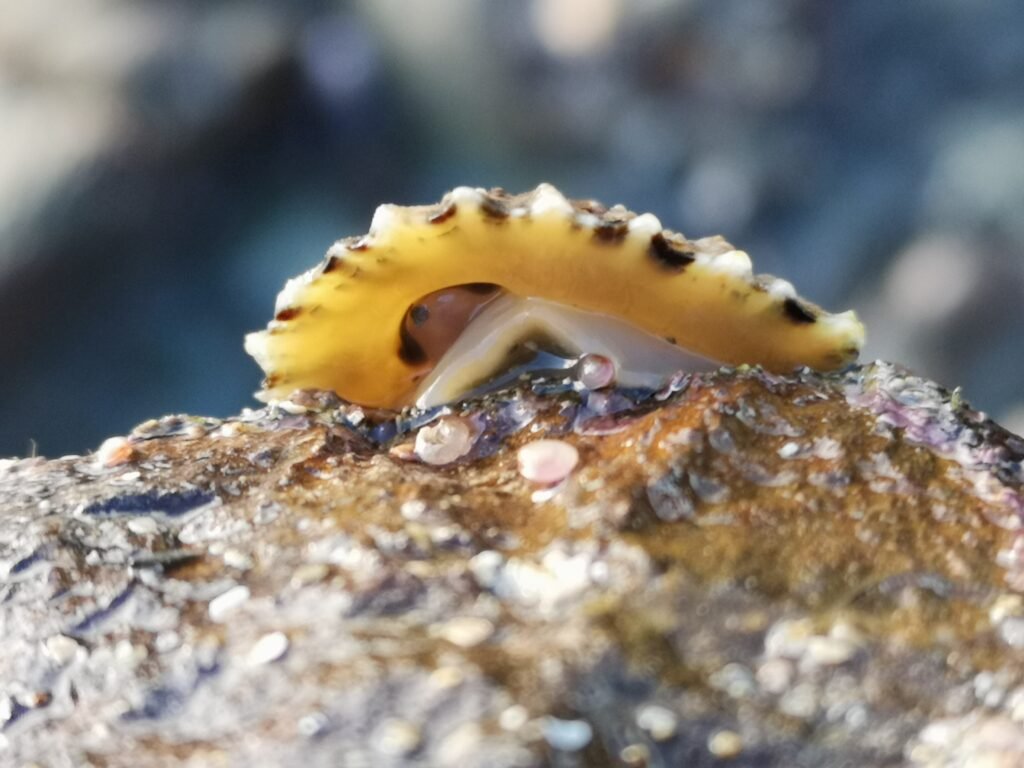
Barnacles, as well as limpets (Patella vulgata) and periwinkles (Littorina littorea) — a kind of sea snail — as far as the eye can see.
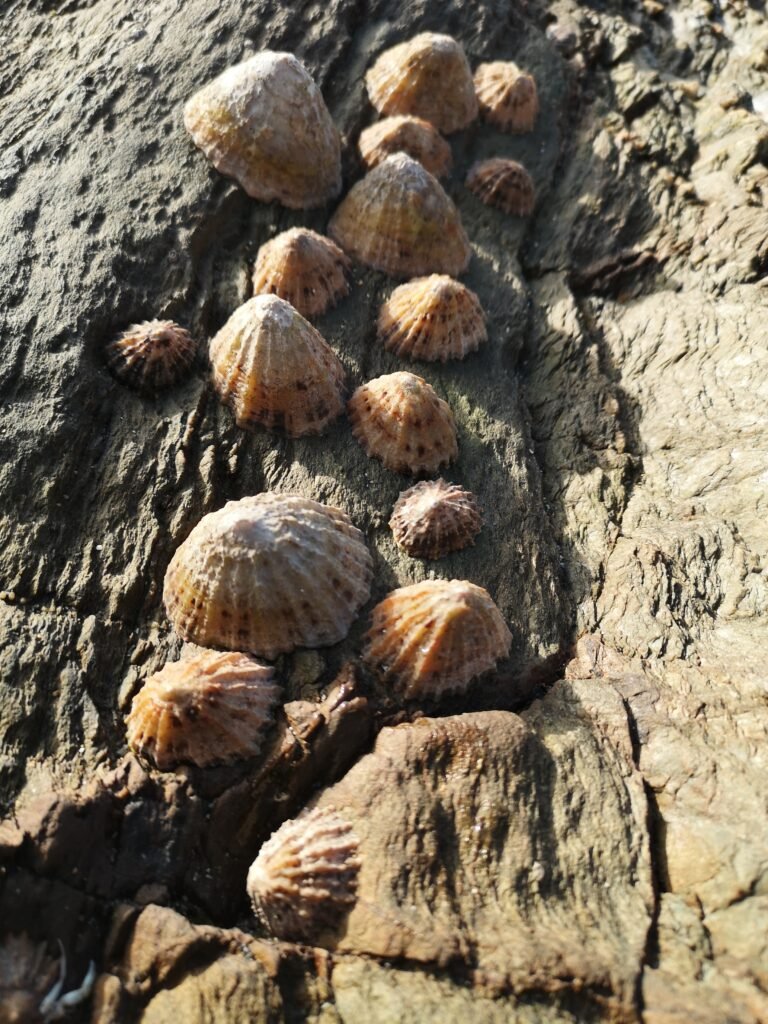
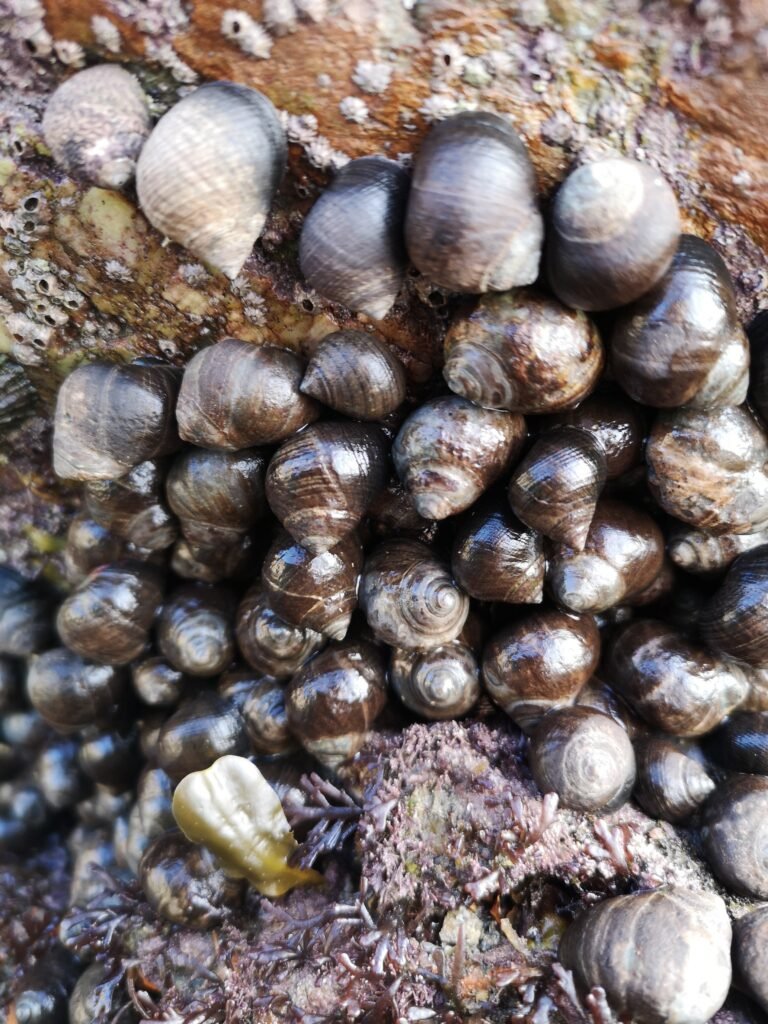
Here’s a photo of ‘The Tiny Three’ together:
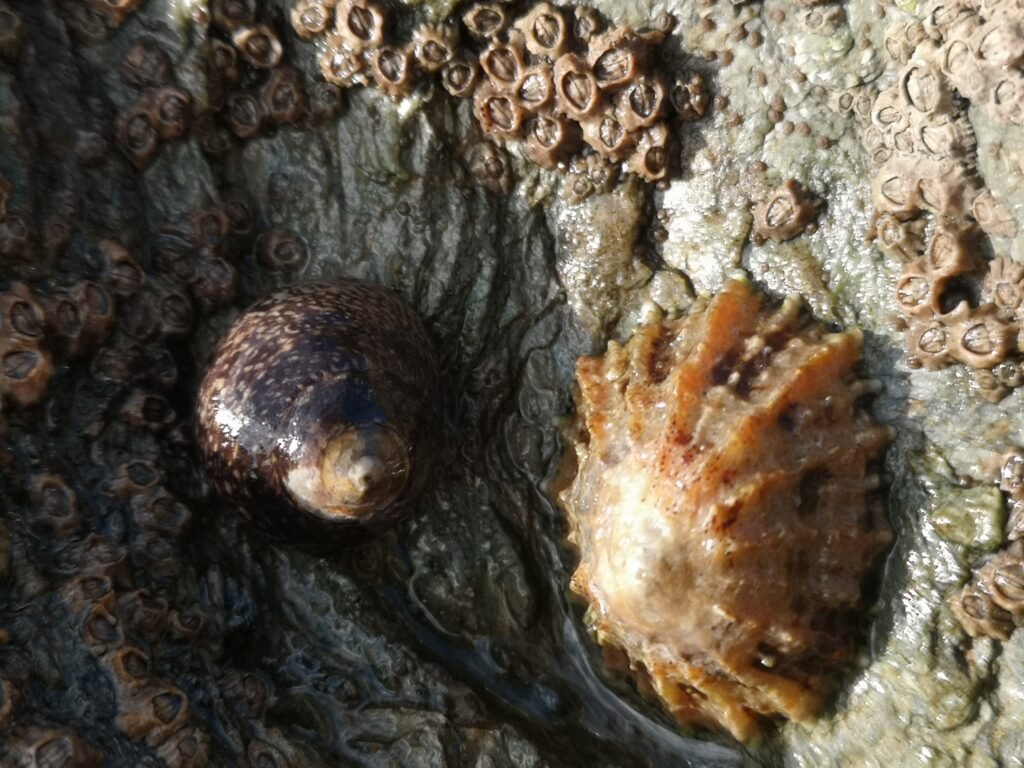
In all likelihood they’re still there. There’s so many of them and they never move when out of water. Not only do they not move, the barnacles and limpets can’t be moved. You can’t pry them off the rocks without using special tools.
So they lay there motionless. Fun fact: limpets can actually move but only when the tide comes in and they’re underwater. Then they move around at a literal snail’s pace, scraping algae off rocks with the toughest tongue in the world. Called a radula (like in slugs), it’s armed with “teeth” made of the strongest biological material known to man.
As strong as kevlar — the stuff that stops bullets!
When the tide goes out again, limpets go back to their favourite spot by following their slime trail like a trail of bread crumbs. They love their spot so much that the rock gradually gets worn away by their shell, creating a circle-shaped “scar”. This helps them attach to the rocks better. These things are putting scars on rocks!
Really slow or not moving: that’s the pace of life for most rockpool residents. Another good example is mussels. Our beaches in the UK have the classic edible mussel (Mytilus edulis). Like a Reddit mod, they barely move…and they’ve got a beard. Kinda. They have a tuft of byssal threads to anchor themselves. And to slowly execute dog whelks.
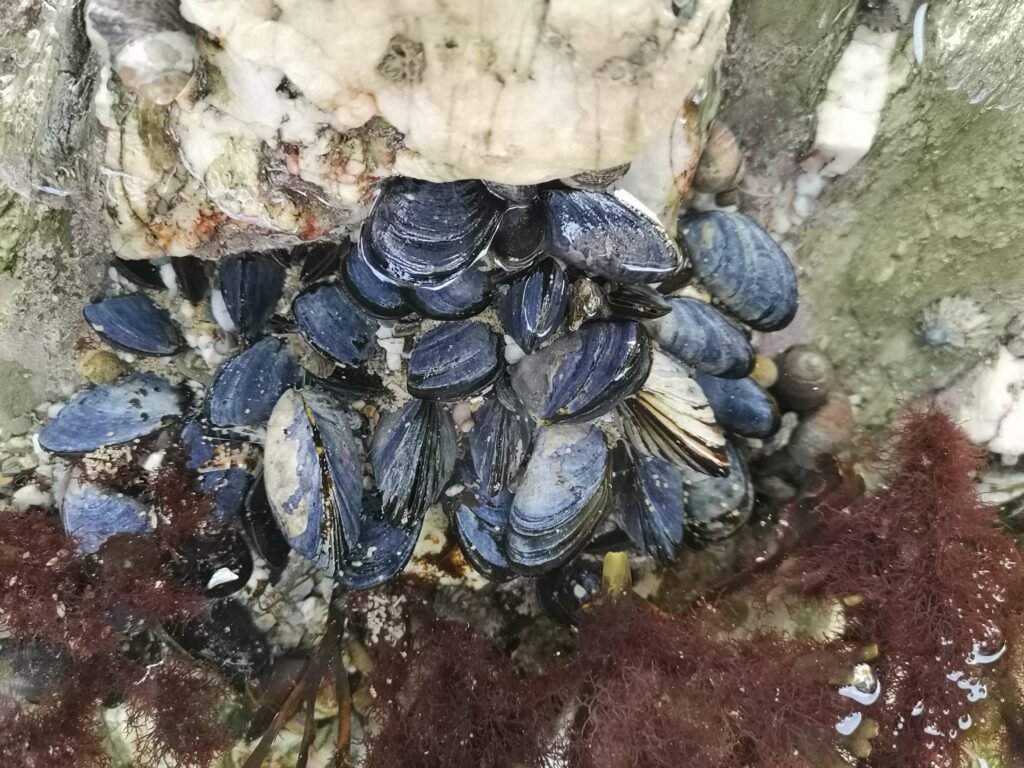
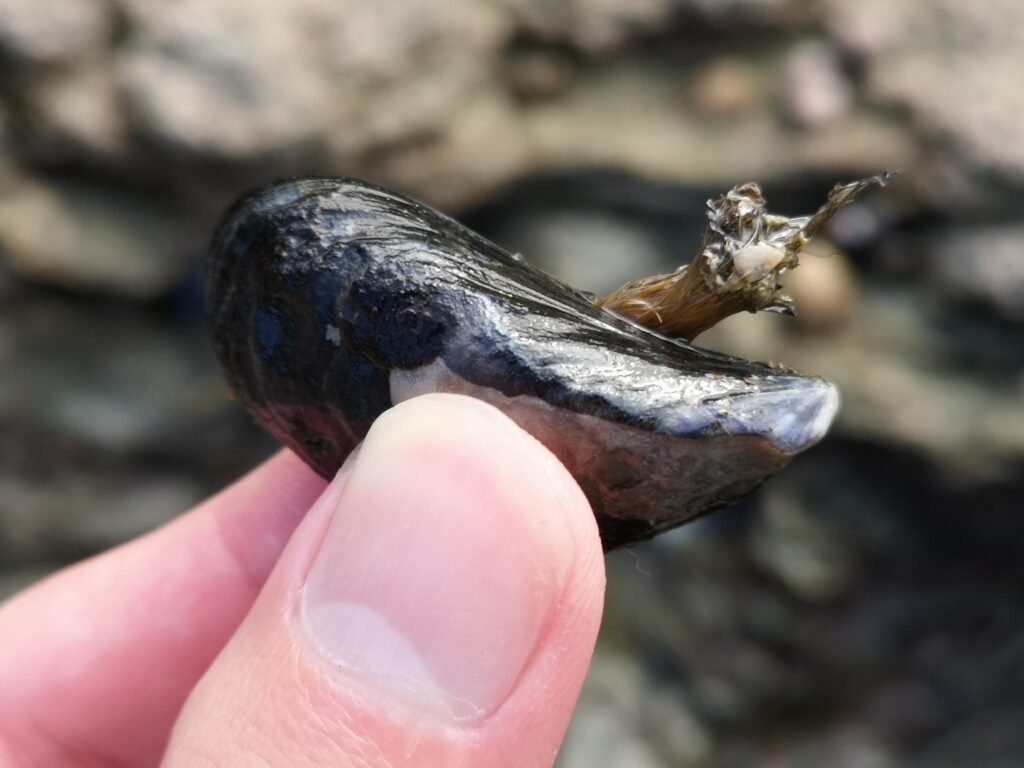
A lot of species that live in and around rockpools evolved adaptations to withstand getting hammered by waves. Mussels anchor themselves with their beard threads; limpets firmly clamp themselves down with their muscular foot.
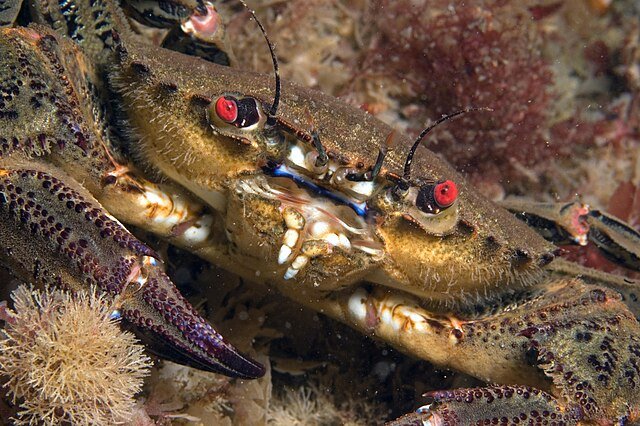
Further up the beach, I found a velvet swimming crab (Necora puber). He was a only a little guy hiding behind a slab of rock. The water was too deep for me to get a clear shot, so I tried to catch him with my hand. Specifically my left since I’d be a little f***ed if I lost any fingers on my right hand.
Jokes aside, do mind the claws. It’s also called the “Devil crab”, probably because of its satanic red eyes and how aggressive it is when you try to handle it. Instead of pinching my fingers, he ran straight into a hole. Maybe for the best.
Speaking of not touching things, don’t touch any of the anemones’ tentacles. Believe it or not, sea anemones are distant cousins of jellyfish. And just like most jellyfish, their tentacles can also give you a nasty sting. So even though they look like flowers, sea anemones are animals.
One such sea anemone is the snakelocks (Anemonia viridis). Looking like Medusa’s hairdo, the main “body” is pale grey while the tentacles are green with purple tips. Scientists missed out on a good opportunity to put “Medusa” or “gorgon” in its scientific name.
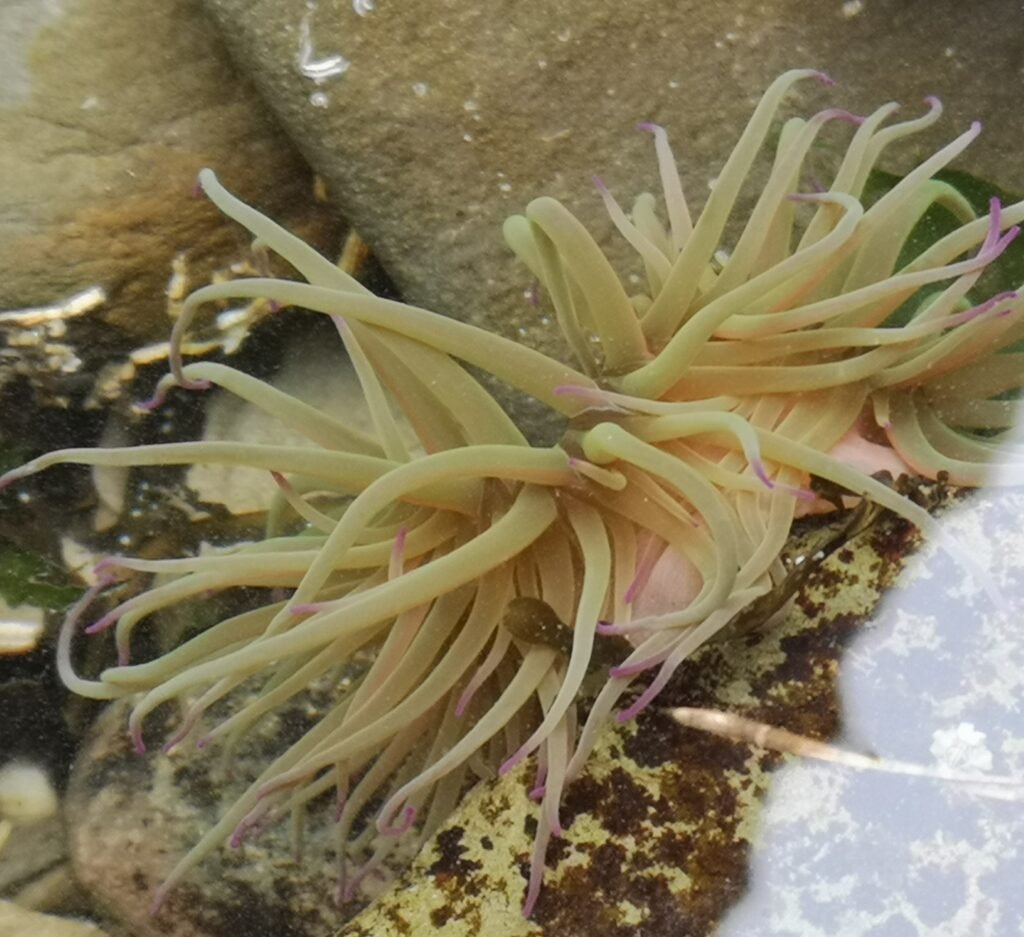
Species like the beadlet anemone (Actinia equina). Much more common than the snakelocks, they’re those dark red blobs that look like blood clots you see on the sides of rocks.
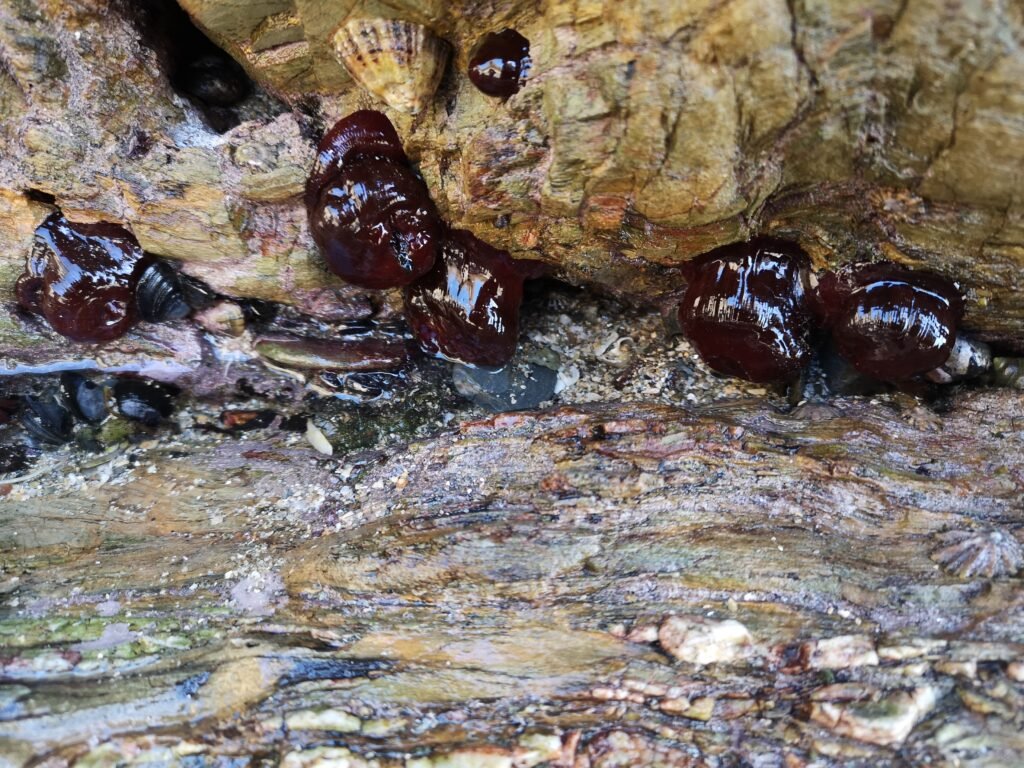
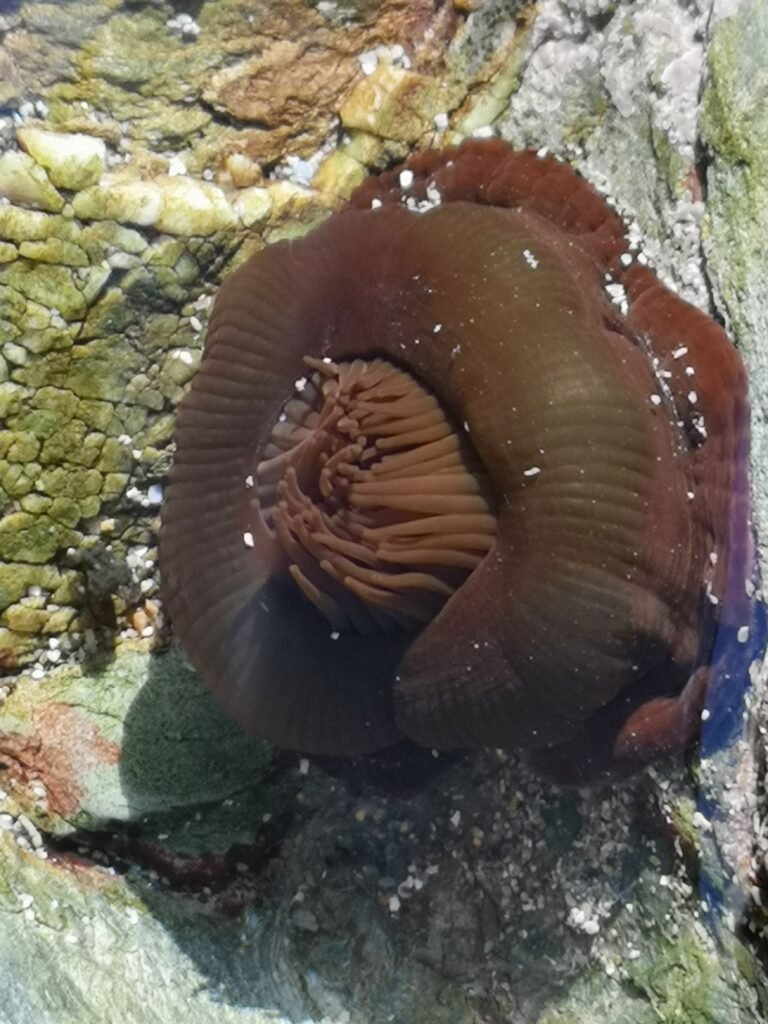
This is when they tend to have their tentacles retracted. With the tentacles inside, they’re safer to touch; they’re delicate so be very gentle. If you’ve ever touched one before, they feel just like a mushy jelly. Or like a panna cotta.
Quick sidenote: as tempting as it is, try not to touch stuff in the rockpools too much so you don’t disturb the environment and the animals. Don’t get me wrong, it’s fun when you’re holding a starfish. But when you’re the starfish who’s being held by a giant, that’s less fun.
Reaching 5 cm in diameter with shorter tentacles, the beadlet anemone is smaller than the snakelocks but stockier. Normally it’s dark red, but can also be green or orange.
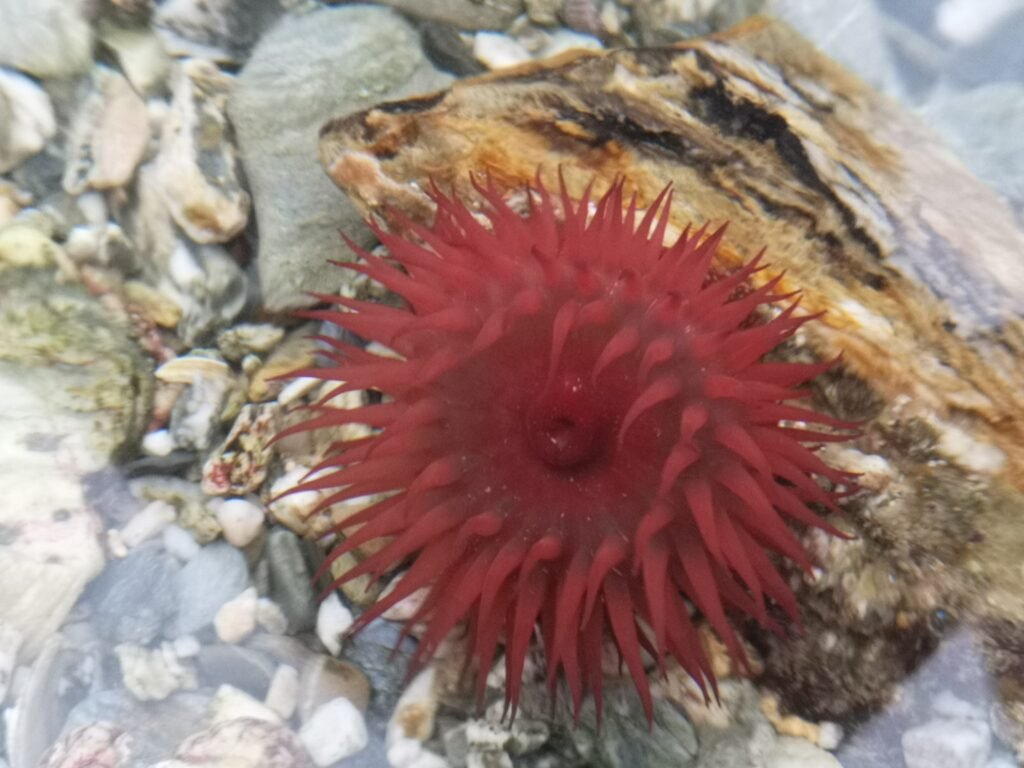
It has a ring of bright blue beads lined below the tentacles called “acrorhagi” (ak-ruh-RAY-jee). Good luck pronouncing that.
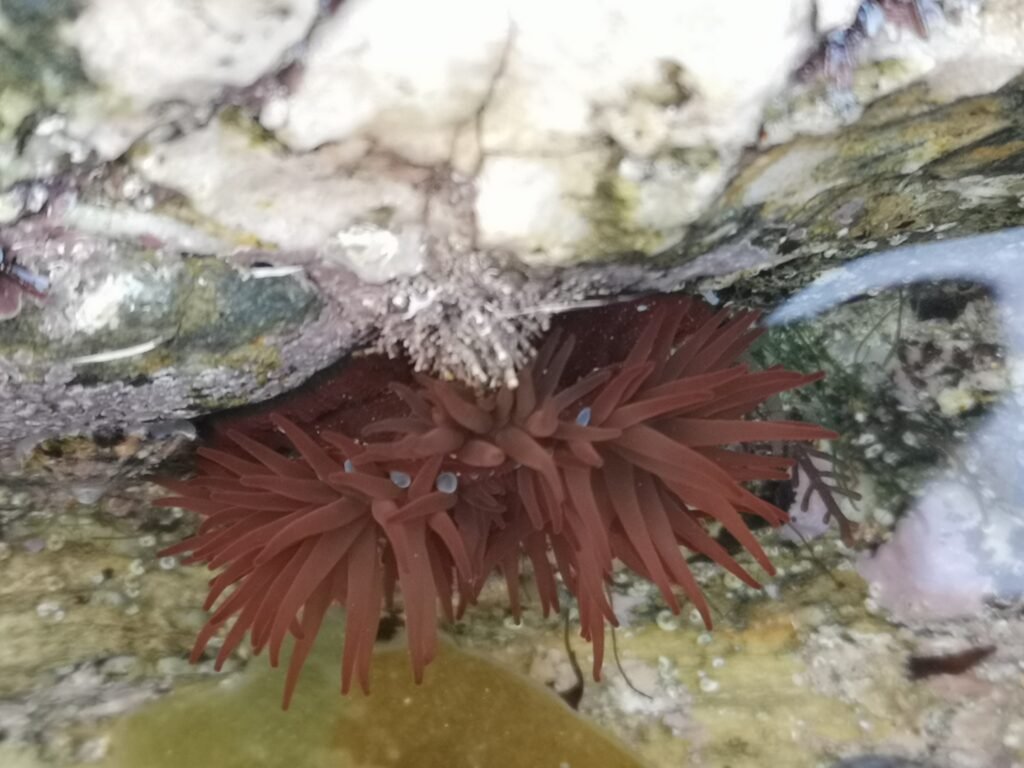
Packed with stinging cells, the beadlet anemone uses these beads to protect its patch from other anemones. If you think our housing crisis is bad, you’d hate living in a rockpool.
Another anemone species I saw was the dahlia anemone (Urticina felina). This species is named after Dahlia flowers, and it’s absolutely beautiful. It can come in oranges, pinks, purples, whites, and yellows. Akin to an undersea flower.
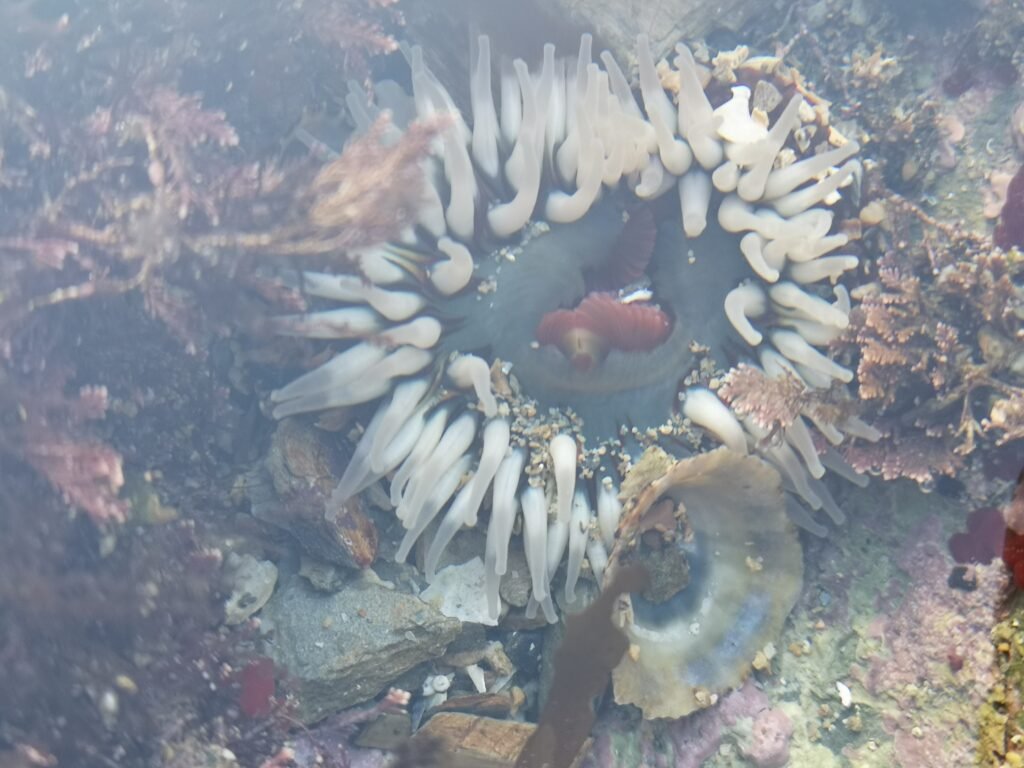
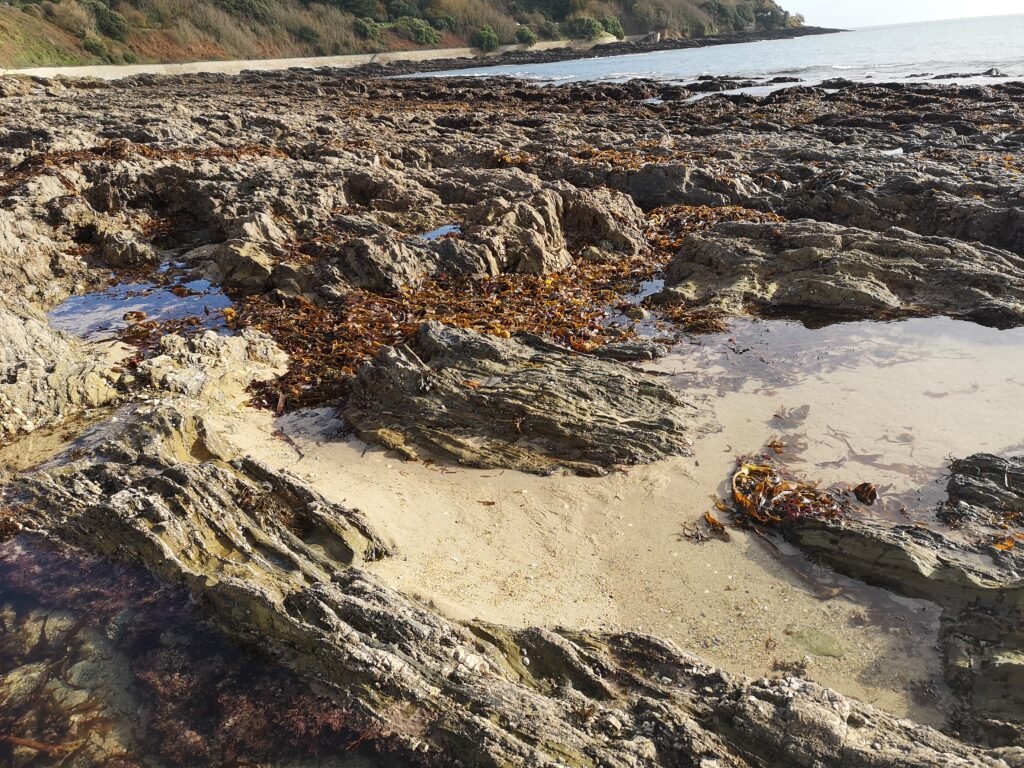
While you’re exploring the rockpools, make sure to keep an eye on the tide. Depending on where you’re at (e.g. an estuary, flat beach, sandbar, etc), the tide can come in extremely fast. Honestly, you’d be surprised how fast those big rocks disappear underwater.
In three hours, all of this will be gone:
Oh, and watch out for the waves.
I had to cut my first visit short since the tide started coming in. I didn’t really feel like drowning, so I dipped outta there while there was still land to walk on. Well played, ocean.
Because each tidal phase takes about six hours, I had a pretty long waiting time. But eventually, night fell and the tide was back to low. So I went back for my second visit. Yes, I visited a rocky beach at night in the dark. The spooky, scary dark. Because mama didn’t raise a b****.
But I did bring a torch in case my phone dies. Don’t judge me.
S*** is wacky during the day; at night, it gets even wackier. More sea creatures come out after dark.
Sea creatures like this shrimp:
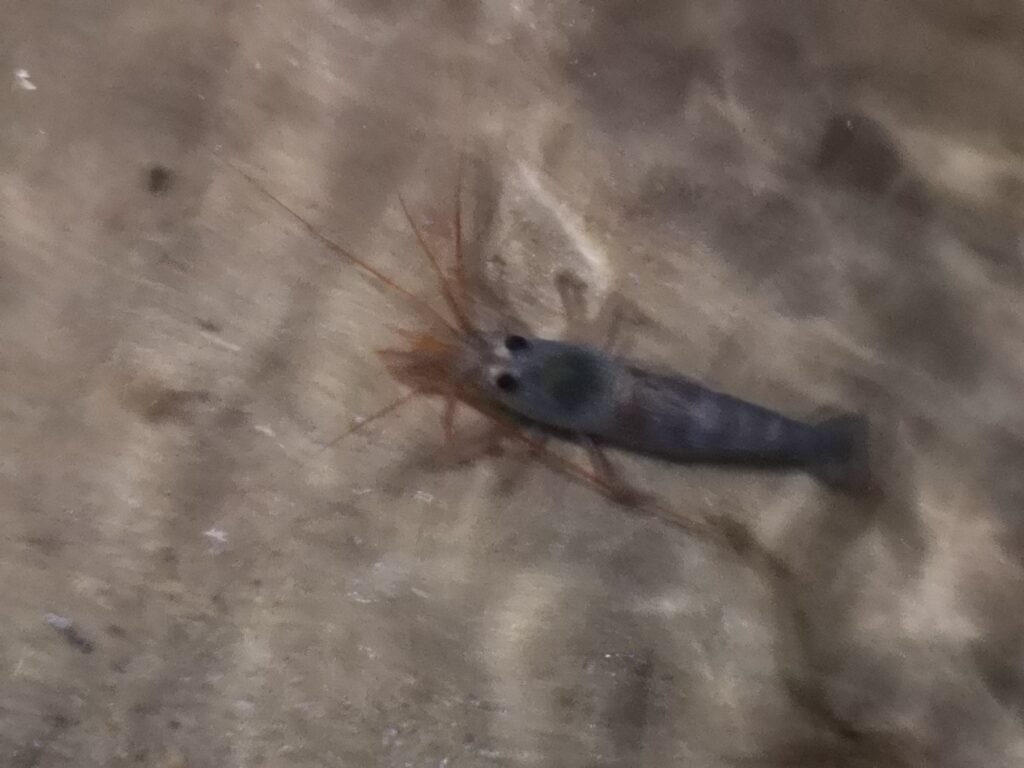
I think this is a rockpool shrimp (Palaemon elegans). Yeah, my photography skills weren’t the best but it was night-time and the shrimp was darting all over the place. I don’t think it likes bright lights — valid. Luckily, I’ve got another photo.
This one was taken while I was on a field trip for my zoology course:
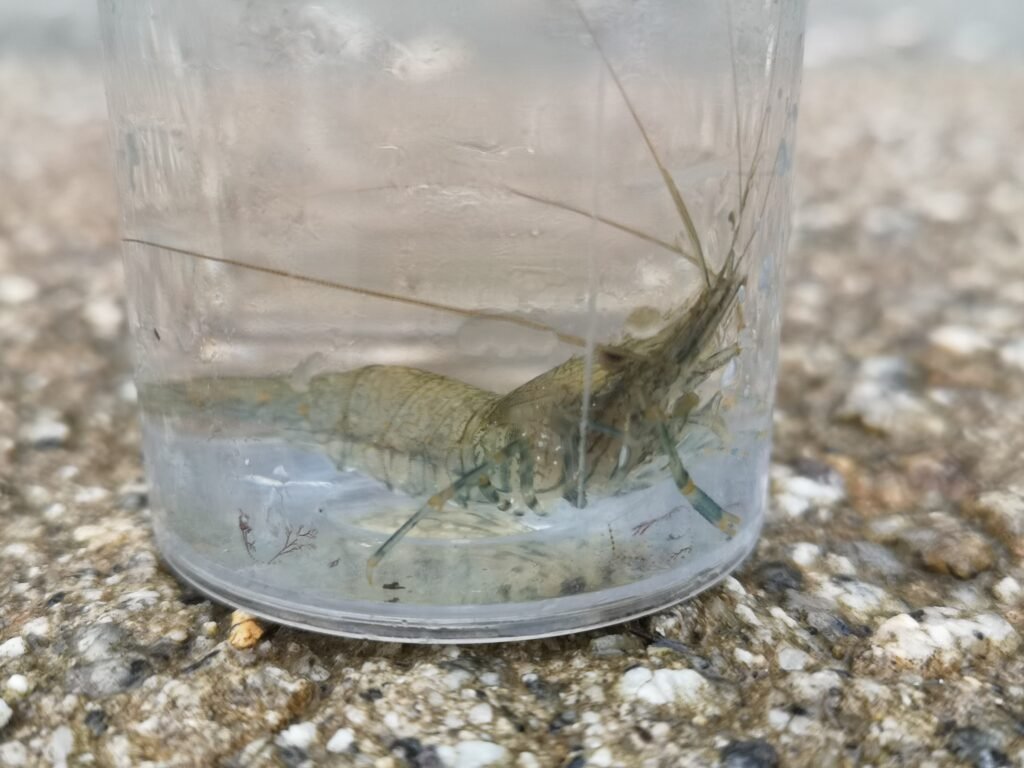
It’s very common across the UK’s coasts and often confused with the closely related common prawn (Palaemon serratus). What’s cool is that it has a transparent or see-through body. Along its body are dark brown stripes, and the legs have blue and yellow bands. You usually find these tiny guys hiding under rocks.
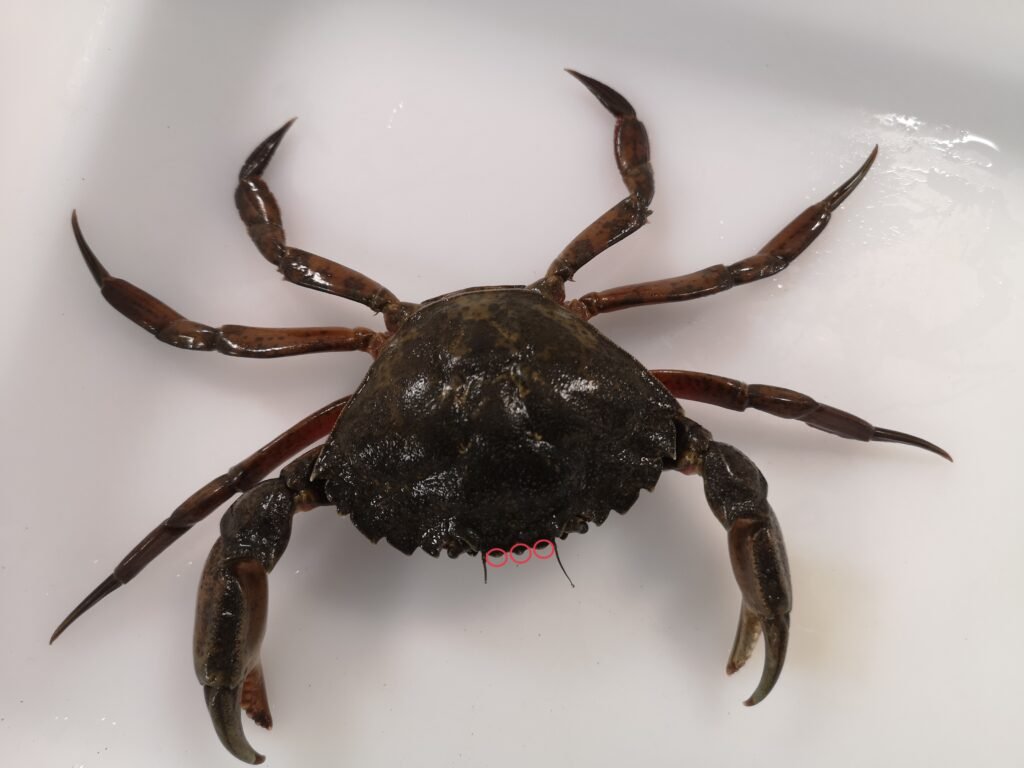
That shrimp wasn’t the only crustacean crawling around that night. I found a European green crab (Carcinus maenas) too.
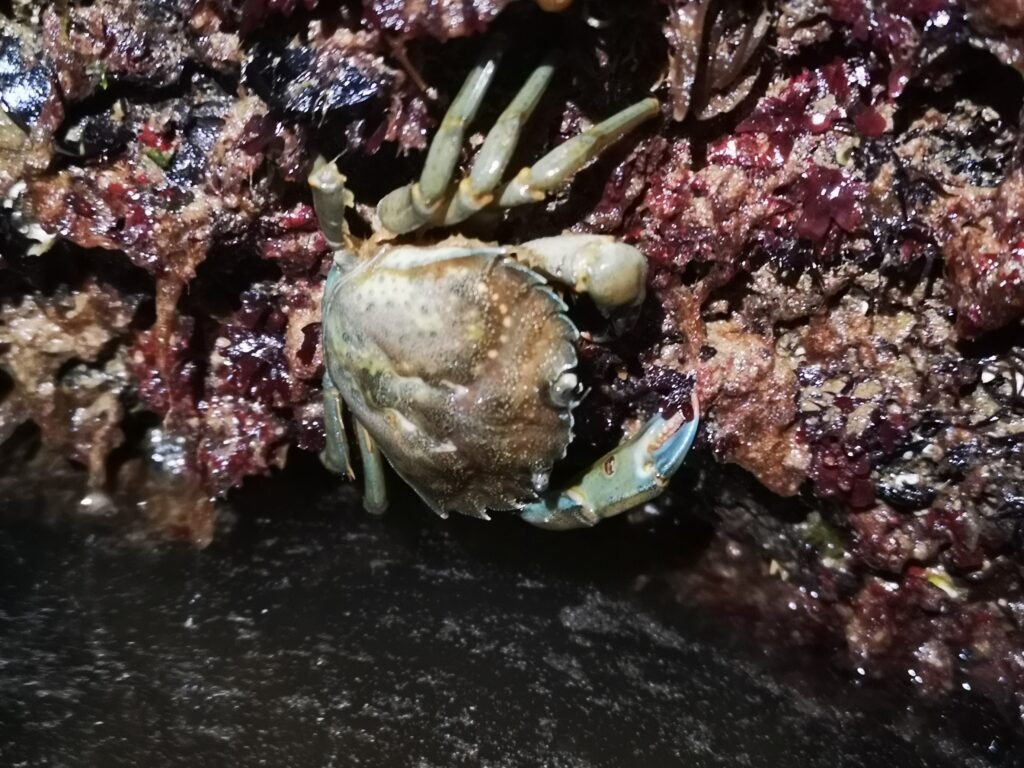
Here in the UK, people call it the green shore crab or just shore crab. Not that that narrows it down. But the name “European green crab” isn’t even that accurate.
It’s not just green: it can also be orange or red. And the “green” is more of a brownish-green like a cabbage…a 3-week-old cabbage.
Perfectly displayed by this crab in the university science lab:
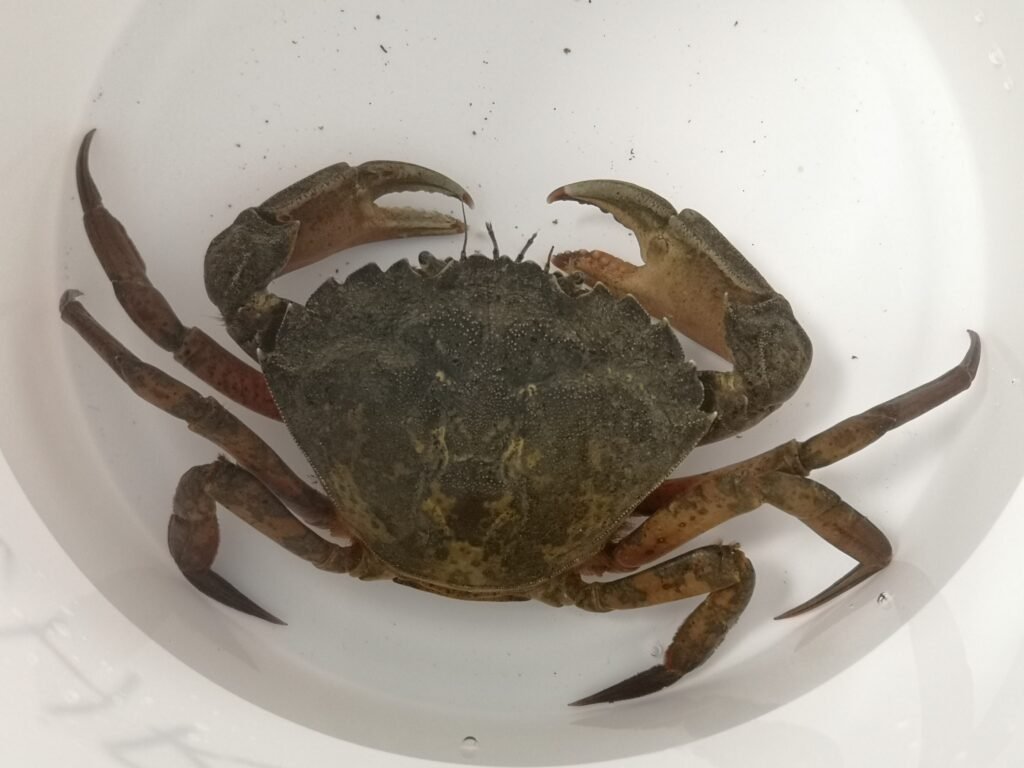
It’s not only found in Europe either. This guy’s on the list of the 100 World’s Worst Invasive Alien Species. It’s gained a foothold (or clawhold) in many regions it shouldn’t be in, including North and South America…and…and Africa…and Asia…and Australia. Basically the world.
So chances are, you’ll bump into this guy on the beach. To ID, don’t look at its colour. Look at the spikes on its carapace (shell). It has five upturned spikes behind the eye on each side.
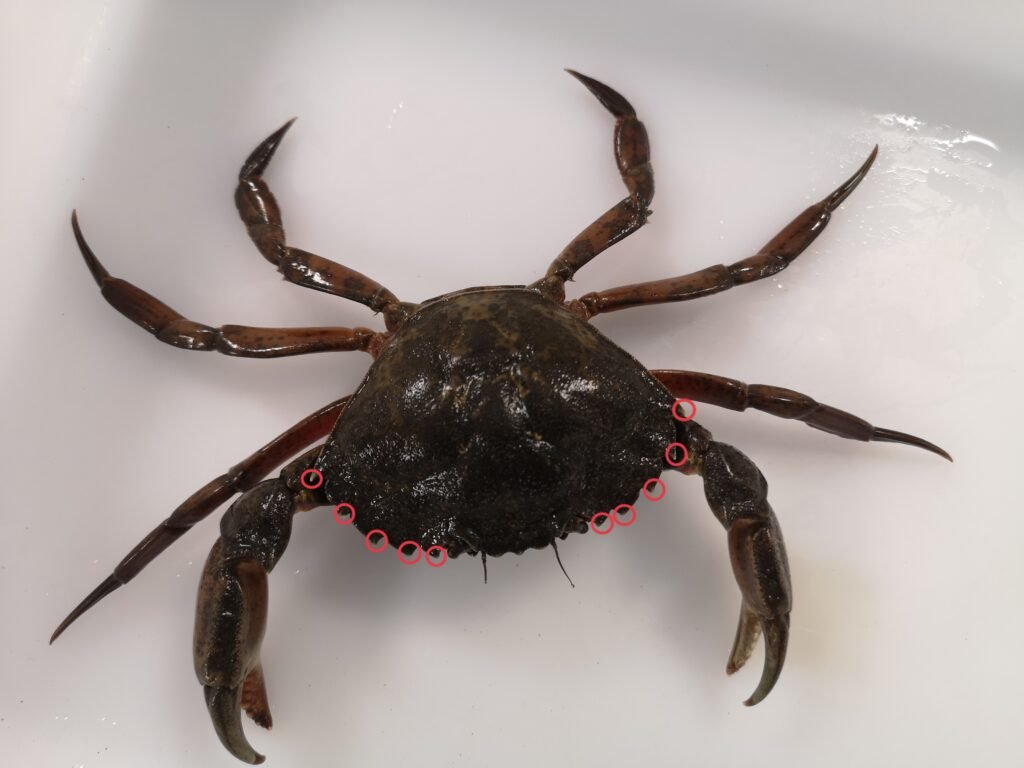
And between its eyes are three rounded lobes.
At this point it was close to midnight, and I was ready to call it a day (and night) and go home.
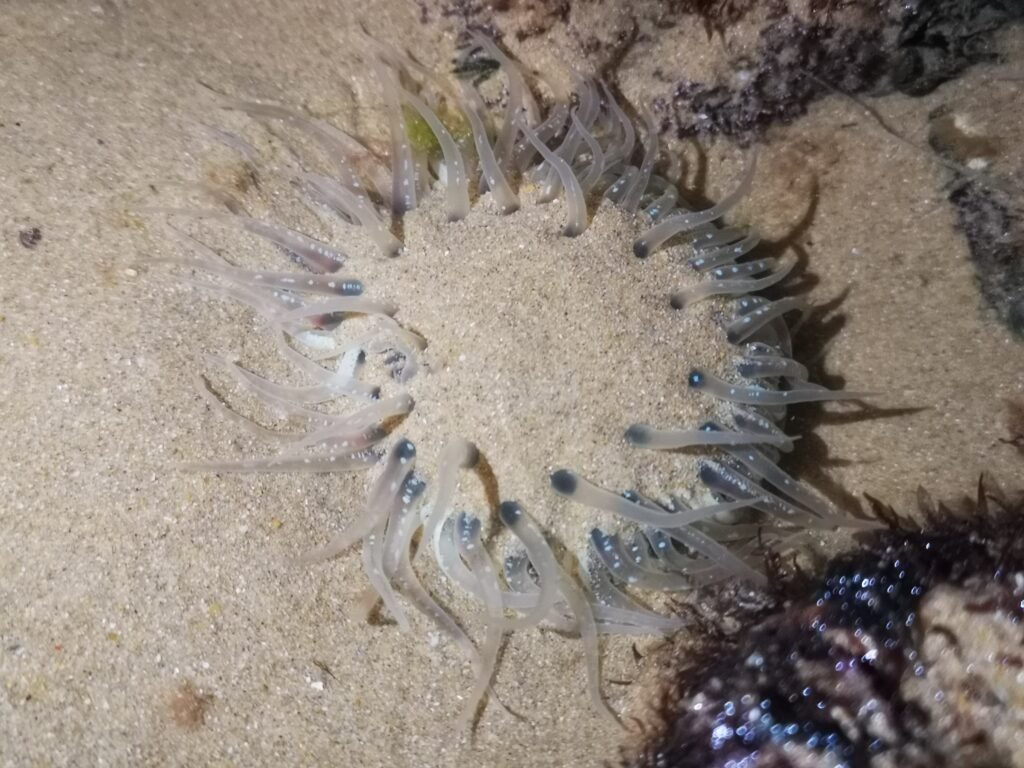
On the walk back, I saw a familiar face. Or so I thought. Well, it didn’t have a face. And it was half buried in sand. What I thought was snakelocks was actually a starburst anemone (Anthopleura sola). Unfortunately for all you trick-or-treaters, it doesn’t taste like Starburst.
Soon after I left the beach and headed home.
Before I end this blog post, I have an important update to give. Remember when I made sloe gin and wrote a post about it? If not, you should go and read it. It’s a treat. Back to the gin.
I’ve kept it in a wardrobe for the last two months (and a week), allowing enough time for the sloe juice to infuse into the gin. And now it’s ready!
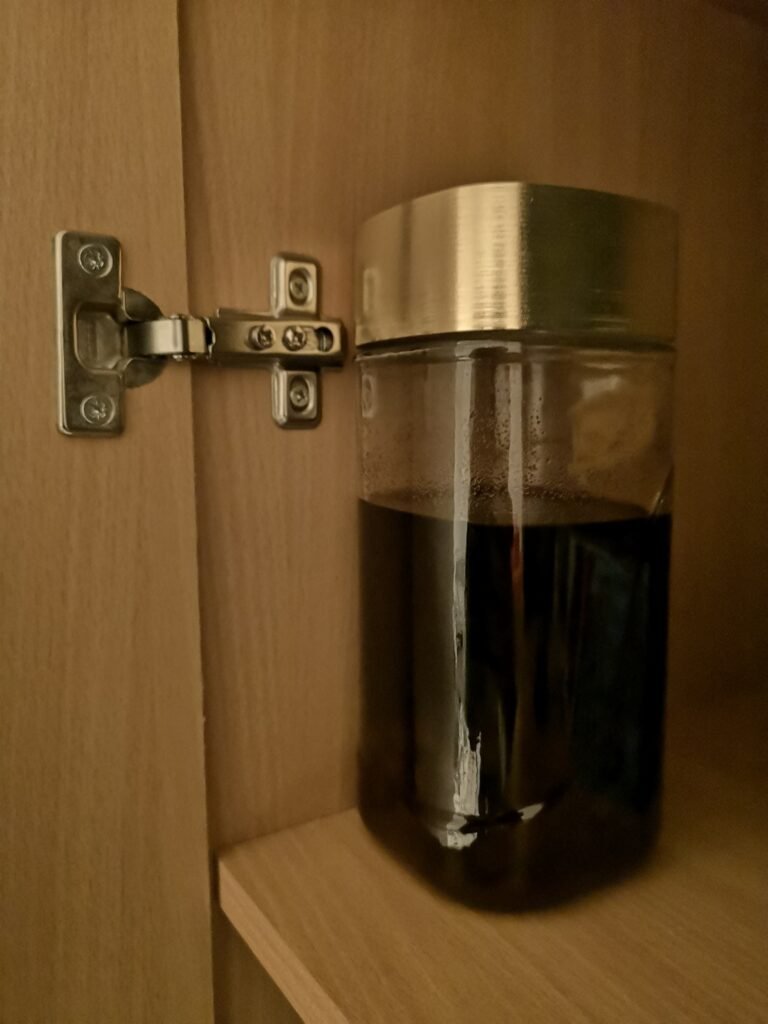
Look how much darker it’s gotten since those two months and a week. That colour tells you everything you need to know: this s*** is gonna be good. Two of my housemates (and honorary sisters) — Amy and Katelin — said they’d offer their critique.
Both being huge Halloween fans, Katelin brought down her black skull shot cups for us to take shots. I’ve never felt so excited to put alcohol inside me.
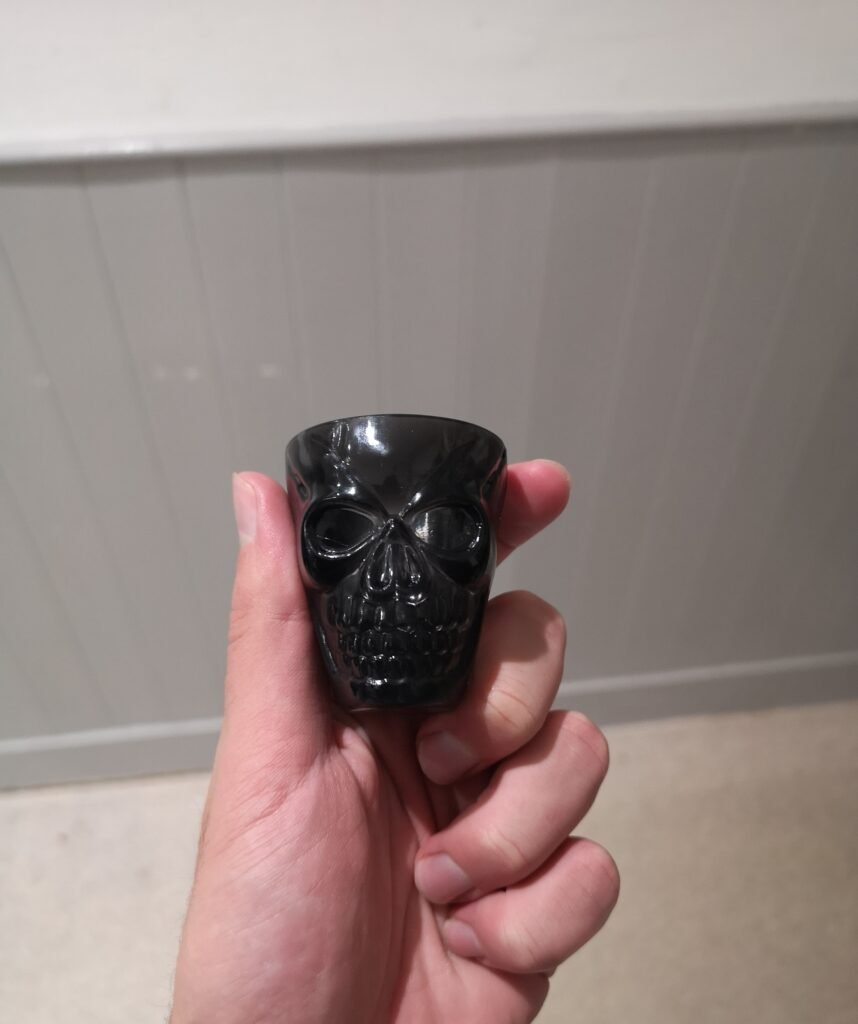
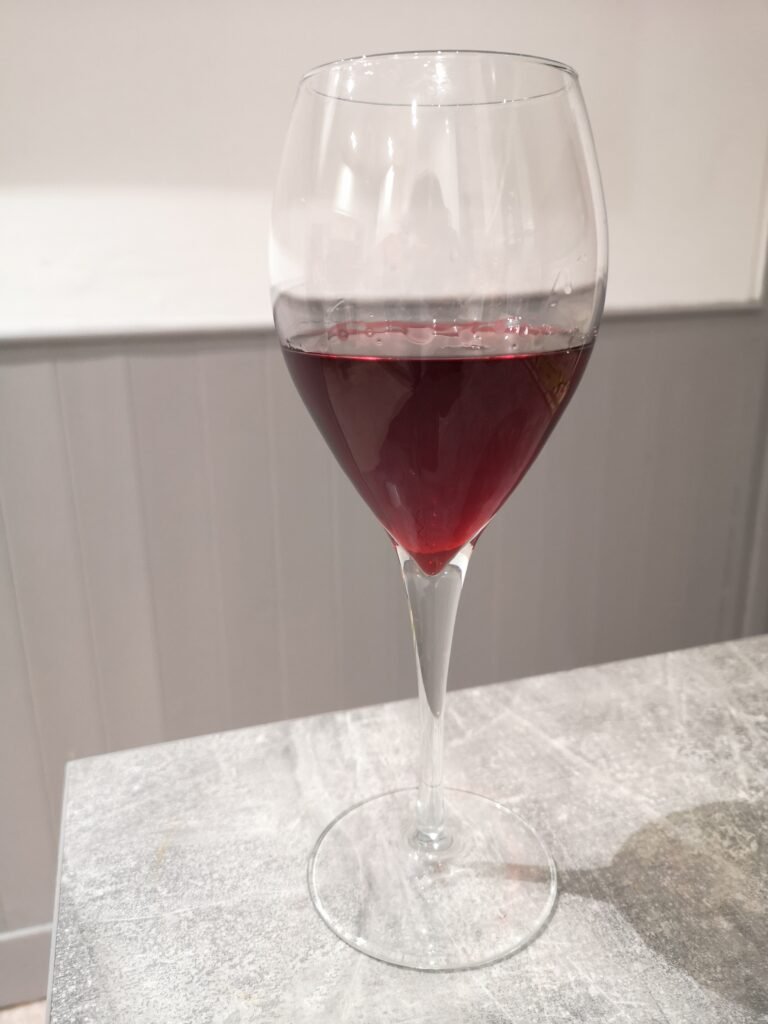
As I was pouring shots for the three of us, I noticed the colour of the gin was actually a rich ruby-red colour.
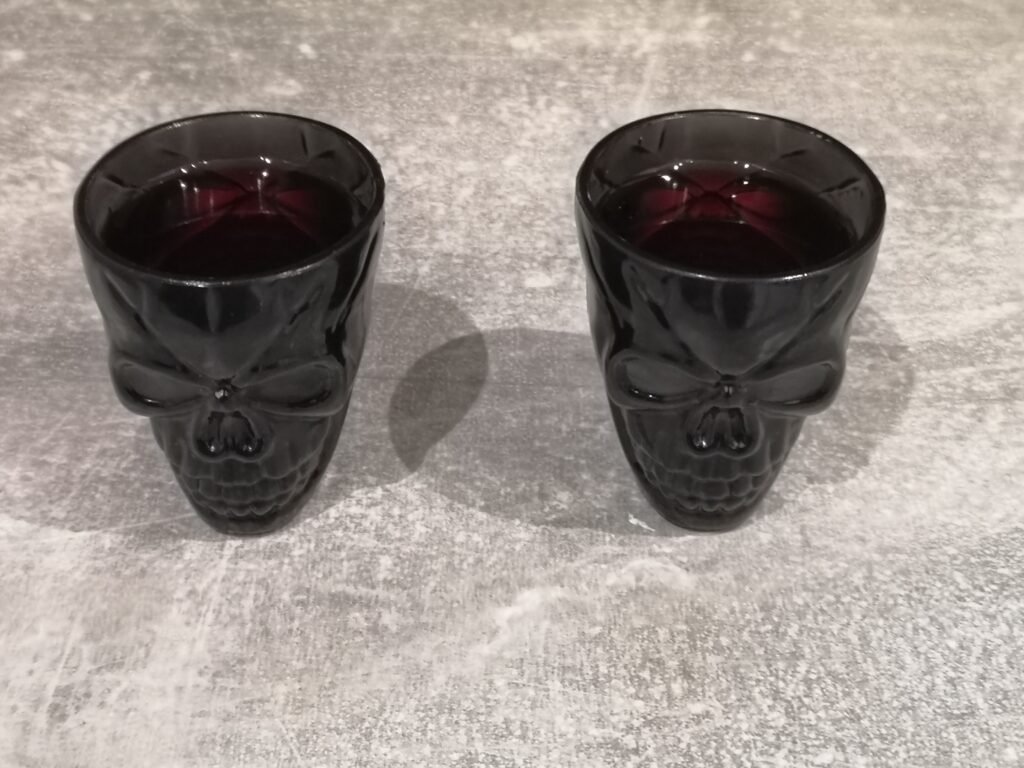
In case you couldn’t see it very well in the black shot cups, I poured some more into a wine glass. It’s kinda freaky how much it resembles blood. But it fits the Halloween theme so I’m all for it.
Amy and Katelin took a sip…and they loved it! Amy even wrote a review like a sommelier.
Here’s how she described it:
“It had the most rich berry taste and was incredibly smooth and light. For those who don’t like the taste of alcohol so much, it’s perfect! Really nice and fruity gin that goes brilliantly with lemonade to add a bit of fizz without overpowering its flavour.”
I said in the blog post that I’d keep you guys updated for when I try it, so there’s my long-awaited update. I hope you all did some fantastic spooking this year.
Happy Halloween! I’ll see you in the next one. Stay straying!